How Digital Menu Boards Drive Sales Across Restaurant Chains
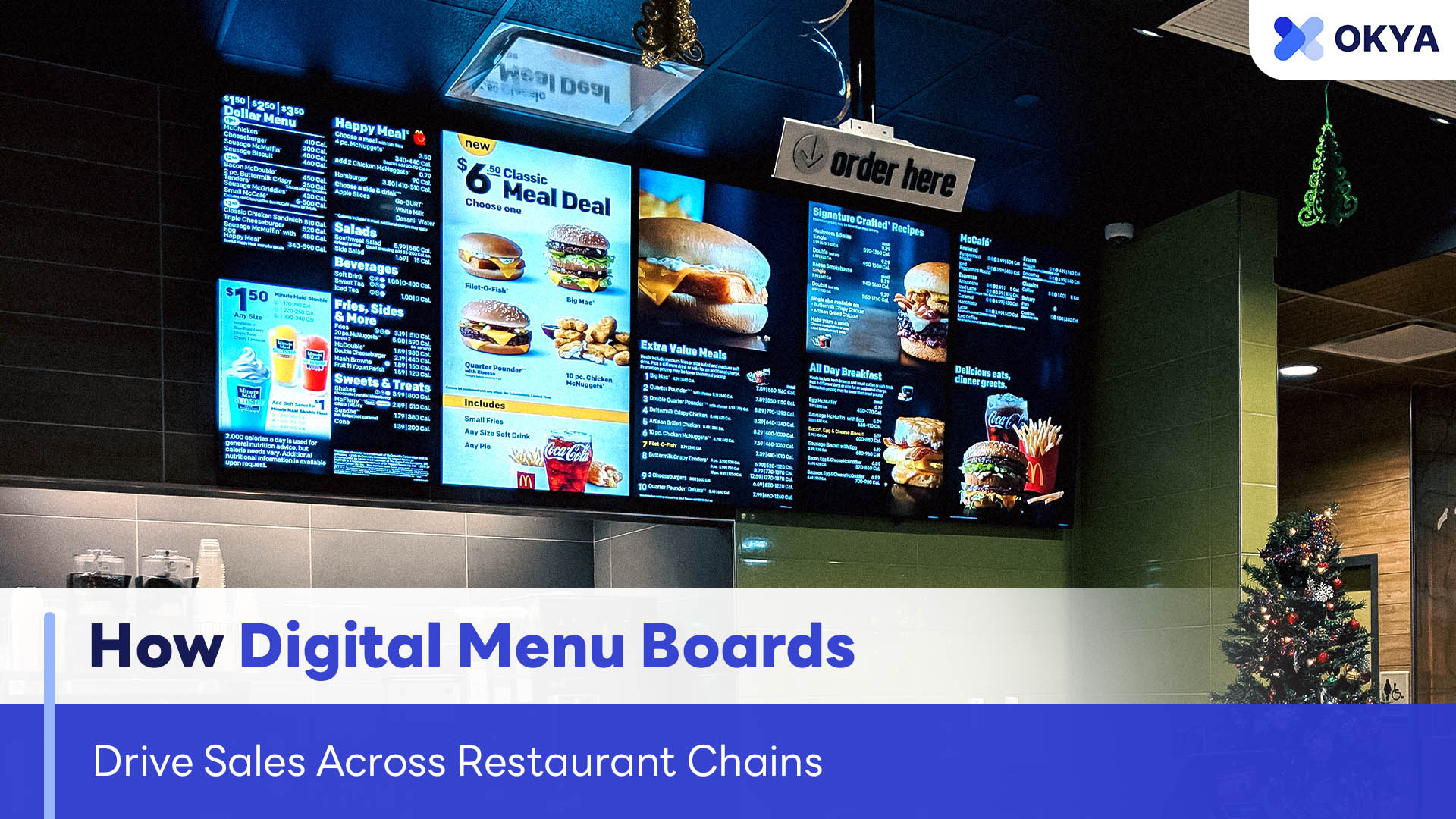
How Digital Menu Boards Drive Sales Across Restaurant Chains
For restaurant chains, consistency is the key expectation customers have. The menu, often the first interaction a customer has with your brand, sets the tone for the entire experience. However, maintaining up-to-date and consistent information across multiple outlets remains a major operational challenge. Digital menu boards solve this by enabling real-time updates, unified branding, and stronger conversion opportunities across all locations.
This article will provide the basics of digital menu board systems and how they sales through real-time content updates and dynamic customer engagement.
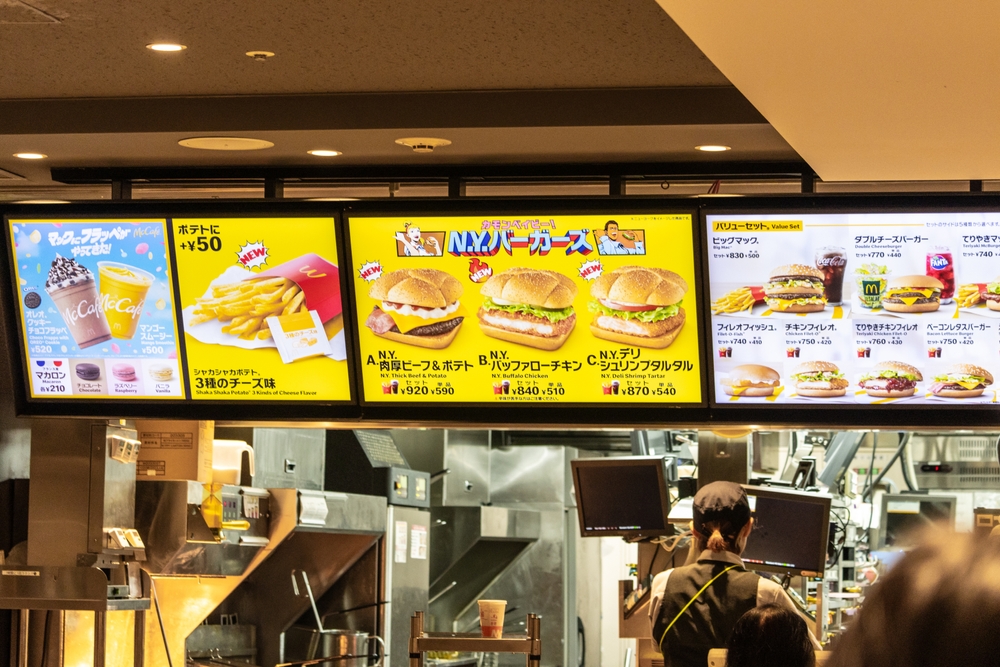
What’s the Difference Between Traditional vs. Digital Signage
Traditional signage refers to the types you’re most familiar with - handwritten boards, colorful printed materials, or eye-catching lightboxes - that have been used for decades. This type of media delivers information directly to customers’ eyes. However, traditional, or “analog,” signage comes with two major limitations. The first is the physical space, each sign can only display a limited amount of information, and there’s only so much wall space to use. The second limitation is consistency and speed to launch. Consider launching a campaign the traditional way: thousands of pieces of media must be printed and installed before opening time. A single typo or last-minute menu change can delay launches, create inconsistencies between stores, and lead to costly waste in both materials and labor.
Digital signage and digital menu boards are being implemented to solve these challenges. By using dynamic, “live” displays to show preferred content in real-time, they offer clear advantages over traditional signage across four key areas:
- Consistency: Digital menu boards maintain a unified look and message across every touchpoint, storefronts, kiosks, and online, and across all locations, from a handful of outlets to thousands. This ensures both a cohesive guest experience and accuracy of pricing, availability, and promotions.
- Real-time updates: As “live” displays, digital menu boards can instantly show the latest menus, promotions, or other announcements. Whether pushing updates chain-wide or managing individual outlets, content changes are deployed in seconds, ensuring everything displayed is available to order in real time.
- Customization: Think of a display as a blank canvas that you can put text, graphics, animation, and even a video on. This enables the creative side of the digital menu board to capture attention and lead to sales. In addition, this also enables dayparting or time-based information, and contextual ads - based on location, events, weather, or any context that drives sales on any items.
- Contextual Relevance: Digital menu boards adapt dynamically to real-world conditions to keep content engaging and relevant. They can automatically adjust visuals and promotions based on factors such as time of day, day of week, weather, or store location, highlighting breakfast items in the morning, cold drinks on hot days, or limited-time offers during local events.
When connected to systems like POS and CRM, they can also sync with active campaigns, inventory levels, and loyalty events, ensuring that every display shows only items that are available and up to date. This creates a data-driven experience that aligns marketing, operations, and customer engagement across all touchpoints.
How Digital Signage Drives In-Store Engagement and Sales
In-store sales are shaped by how effectively you capture attention and influence decisions at the moment of purchase. While customers may enter with a specific product in mind, what they see and how it’s presented often determines what — and how much — they ultimately buy. This is where digital menu boards and in-store signage create impact, guiding both intended and impulse purchases through clear visuals, contextual promotions, and data-driven content.
This is where digital menu boards and digital signage elevate the process through two primary mechanisms.
1. Enhancing Intent-Driven Purchases
Digital menu boards strengthen intended purchases by providing dynamic, visually rich confirmation of what customers already want. Instead of simply stating “Cheeseburger – 99 Baht,” they display realistic imagery, motion, and context that make the product more enticing. Beyond that, they can react to changing conditions in real time — highlighting limited-time discounts (e.g., Cheeseburger now 89 Baht for the next hour) or automatically promoting alternatives (Fish Burger with Cheese) when an item is out of stock.
2. Stimulating Unplanned Purchases
Once initial demand is met, digital signage can drive incremental revenue by inspiring impulse buys. This can be achieved by showcasing nationwide promotions customers may not yet know about, highlighting high-margin combos, or running time-based offers triggered by live data. When connected to POS and CRM, these displays can even respond to localized insights — promoting items trending in that specific region or reinforcing loyalty rewards that encourage larger basket sizes.
Powering Consistency at Scale: The Infrastructure Behind Smart Displays
True digital signage for restaurant chains isn’t defined by screens, but by systems. To scale across multiple outlets, every display must be powered by unified data, real-time synchronization, and automated control—otherwise, it becomes just another static sign.

To make your digital signage and menu boards truly smart, capable of updating, synchronizing, and engaging customers in real time, three foundational components are essential:
- Product catalog: Think of this as your digital “menu master file.” Your product catalog will provide synced information to your digital signage and digital menu boards but also to yourPOS, Kiosk, Digital Application, and even 3rd-party delivery apps - with 100 percent accuracy and consistency throughout every touchpoint.
- Content Management System: Beyond menu items, your displays also communicate promotions, brand visuals, short clips, and QR codes. A CMS is the engine that determines what content appears, where, and when. It enables real-time control across all locations—ensuring brand consistency, localized customization, and automated content scheduling using data-driven logic rather than manual updates.
- Synchronization mechanism: Synchronization in a restaurant chain must operate on two levels. Across outlets, it ensures real-time consistency across all locations—eliminating outdated menus, mismatched visuals, or conflicting promotions. Within each outlet, synchronization coordinates multiple screens so that each display serves its intended role—menu boards above the counter, promotional screens at entrances, or pickup status displays—without repeating identical content.
This two-tier synchronization system enables brands to deploy, update, and manage all displays—from a handful to thousands of restaurants—through a single centralized platform, maintaining brand consistency and operational efficiency at every touchpoint.
Smart digital signage and menu boards allow brands to deliver the right message to the right audience instantly—reducing manual effort, minimizing errors, and ensuring a consistent brand experience that drives both purchase intent and upsell opportunities.
Okya’s Digital Signage Is Designed for Enterprise Scalability
For restaurant brands looking for consistent brand communication and user experiences across multiple locations, they are in need of display screens that show menus, but also a comprehensive content management system that synchronizes with operational systems to maintain consistency while enabling real-time updates. With Okya, your digital menu boards and in-store displays become part of a connected ecosystem that informs and engages customers across thousands of screens — all managed effortlessly from one platform, without errors or inconsistencies.
Built for enterprise and multi-location restaurant brands that need rapid deployment with centralized control from the start, Okya is a solution that helps your restaurant brand deliver true Online-to-Offline (O2O) connectivity through its modular architecture. From day one, the platform includes all essential infrastructure for smart signage operations: unified product catalog and pricing management, a cloud-based content management system for instant updates, real-time synchronization across all outlets, dayparting and scheduling tools, and POS integration for live menu accuracy. All that’s left is your display hardware — industrial-grade screens that bring menus and promotions to life in vivid, dynamic ways.
Trusted by the fastest growing brands across Asia looking to unify their operations and scale globally, Okya provides a ready-to-deploy digital signage solution built for performance at scale. The system is optimized for multi-location operations and helps restaurants deliver both consistency and localized flexibility, helping brands increase engagement, streamline updates, and drive incremental revenue at every touchpoint.
Whether you’re a small restaurant implementing a digital menu board at select locations or a large chain requiring synchronized content management for thousands of screens across hundreds of outlets, if you are interested in the implementation of Okya and its integrated digital signage system in your restaurant, our team is ready to provide a personalized demonstration and consultation to show how Okya can power your brand’s next stage of growth.