Choosing the Best POS System for Multi-Location Restaurant Brands
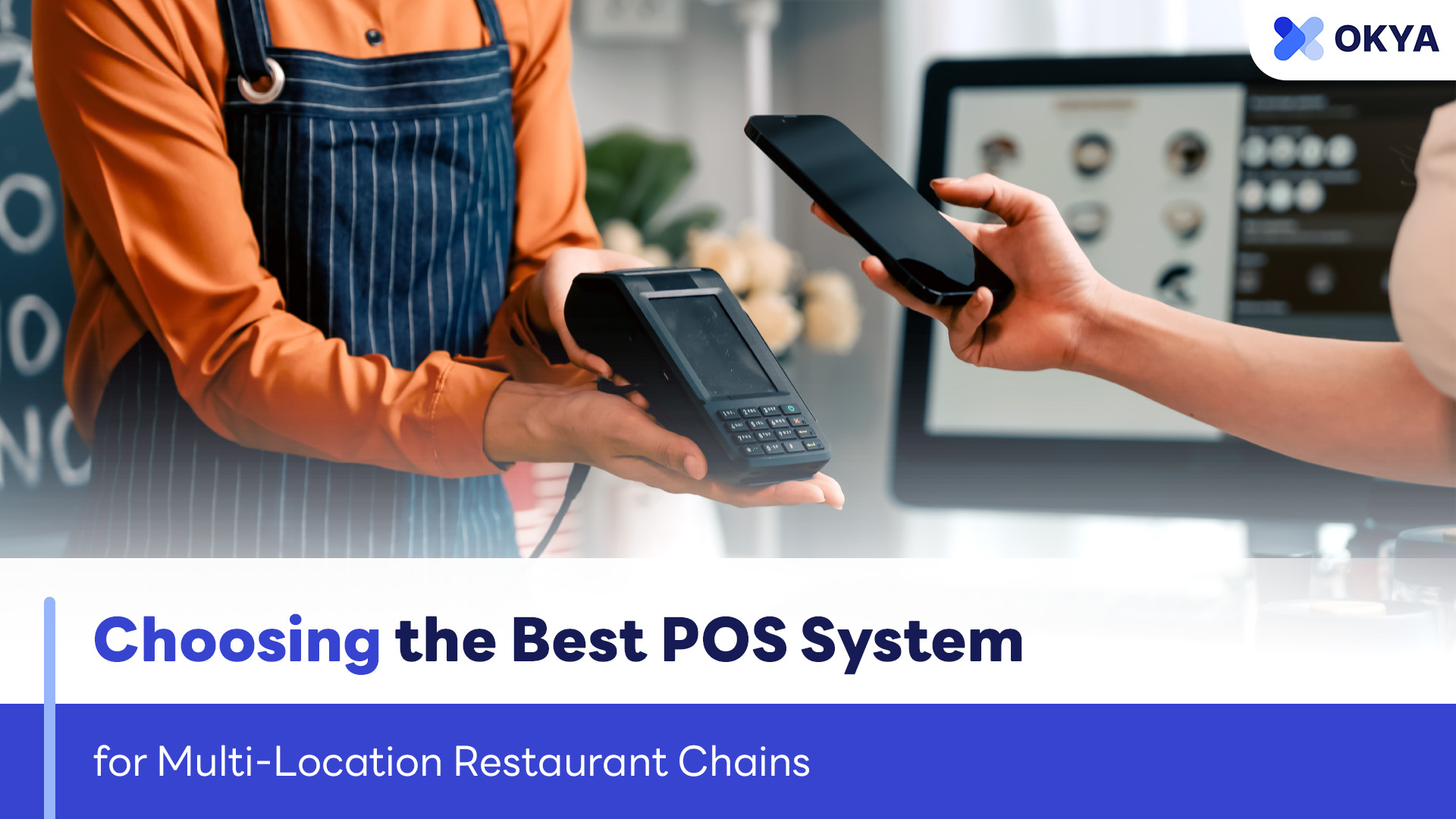
Choosing the Best POS System for Multi-Location Restaurant Brands
Today’s restaurants don’t just serve food, they serve experiences across multiple channels. Guests expect the same speed, pricing, and personalization whether they’re ordering at the counter, kiosk, or app. For brands managing multiple locations, a POS that connects every touchpoint into one ecosystem isn’t optional, it’s the key to consistency and growth.
This article explains how a connected POS system helps restaurant chains streamline multi-location operations, unify O2O guest experiences, and choose a platform built for long-term scalability.

What Could Go Wrong When Managing Multiple Sales Outlets?
While managing a single restaurant is a difficult task on its own, overseeing multiple outlets simultaneously is even more complex. Scaling from one restaurant to ten introduces a different kind of challenge, operational chaos. What once worked when the owner could personally oversee everything quickly breaks down across multiple outlets. Without connected systems, every new branch multiplies inefficiency.
Here’s what typically goes wrong when managing multiple sales outlets:
- Consistency: Customers expect their preferred choices to be available at all your outlets. However, these experiences can be blocked by outdated menus, different pricing schemes, or staff who are unaware of a new promotion. This confusion can cause customers to buy less or leave without a purchase. In addition, these issues are difficult to fix with manual processes, ultimately damaging both the customer experience and the brand's reputation.
- Continuity: Managing a kitchen with a larger scale also comes with a significant challenge: delivering orders just in time and using accurate recipes to maintain taste and quality, all while keeping costs under control. Keeping track of orders, recipes, and inventories in the traditional way becomes impractical, not only for the operation itself but also for the training of the staff to work effectively. Without a reliable kitchen, your restaurant may struggle to become a consistent source of profit..
- Oversight: With multiple outlets under your management, a sustained flow of real-time data of each outlet - especially on cost, profit, and store performance is necessary to ensure you are not left blind to what is happening in each store. Without the necessary data, there is no other reliable way to warn you about any problems or wrongdoings until it is too late.
In conclusion, attempting to scale an operation without an appropriate support foundation not only increases complexity but can also lead to slower decisions, missed opportunities, and—most critically—your brand losing its appeal with customers.
How Does an Advanced POS System Help Deal with Challenges?
One of the necessary steps before expanding your restaurant into a multi-outlet brand is considering the aforementioned challenges of consistency, continuity, and oversight. Your brand should deploy infrastructure for centralized, real-time multi-location control, enabling the deployment, operation, management, and monitoring for all outlets from a single point.
Among all digital tools, the POS stands as the operational backbone of any restaurant chain. Investing in an advanced POS should be a top priority for every multi-outlet brand because it drives consistency, visibility, and control across every location. Beyond serving as a point-of-sale, it forms the foundation that connects your entire operation from the storefront to the kitchen, enabling improvements like the following:
- Implementation of common storefront: With a POS system deployed, you can launch new menus, pricing, or promotions to all points-of-sale with a single click. In addition, a POS system can significantly improve the quality of service, as it provides clear information to both customers and staff and reduces human errors through a simpler workflow that is easy to use.
- Deployment of kitchen management system: With orders and other information digitalized through the POS system, orders become easily visible and trackable by staff. In addition, the POS system enables the integration of other tools like kitchen display systems, recipe management, and inventory control, which helps increase the consistency, quality, and speed of the kitchen.
- Real-time availability of data: Not only are income and sales volume recorded, but POS systems also enable access to valuable data that helps you better understand your customers, your menu, and your branch performance, which helps you plan and implement tactics and strategies more effectively.
In addition, a POS system has several capabilities that support the expansion and profitable operation of multiple sales outlets, including:
- Scalable: With a reliable POS system ready to deploy, expansion can be done in terms of quantity or touchpoints, such as storefronts, kiosks, mobile units, online, or 3rd-party vendors; all while maintaining a unified customer experience.
- Better operational efficiency: With easy-to-use, informative, and automated POS systems, not only is less manpower required, but also fewer training hours are needed. This means you can reach performance targets without increasing your workforce or training demands.
- Transparency: With every transaction logged and monitored through a POS system, it eases the process of accounting and auditing. In addition, it helps management detect any abnormalities at a stage where the damage is still controllable.
What to Look for When Deploying a POS System for Your Restaurant Chain?
When we discuss POS systems, we are not referring to just cash registers, but to the complete package of hardware, software, and other infrastructure related to your sales procedure. Here are some guidelines for selecting an effective POS system that is worth your investment.

Your POS system must meet these three minimum requirements, which are the core functions of the system itself.
- Usability: The POS system itself must be easy-to-use, which can be achieved through a properly designed user experience and user interface, and the provision of efficient training and support documentation.
- Reliability: To maintain the continuous operation of a POS system, the system itself must be reliable, which depends on three factors: 1) reliability of hardware and software; 2) capability to work online or offline; and 3) support and services.
- Security: Speaking of security, a POS system must not only meet minimum hardware and software security standards, but also provide enterprise-level security controls—such as access, permissions, and identification—to make the system less vulnerable to possible threats.
Meanwhile, to enable centralized, real-time multi-location control, your new POS system must be capable of:
- Unification: The POS systems that bring in consistency through every touchpoint possible through unified interfaces and a reliable synchronization mechanism
- Customization: The POS systems that could adapt not only to your procedure and workflow but also to specific needs from localized special menu, limited-time promotion, or variable pricing scheme.
- Integration: The POS systems that are ready for necessary integration for your expansion from payment gateways, CRMs, SAPs, or any necessary 3rd-party applications for your operations.
- Automation: The POS systems that simplified the process to the minimal necessary, which helps improve the speed and lower the errors.
- Analytical and Dashboard: The POS systems that not only collect data, but also synthesize it into useful insights that help inform your decision.
- Flexibility: The POS systems that support every hardware available today - desktop, mobile, kiosks, or in the future.
- Quick Deployment: The POS systems that are ready to deploy “out-of-the-box”, and constant provision of upgrades and updates that do not interrupt the normal services.
Okya: The Solution that Serves Your Needs, Today and Tomorrow
For restaurant brands looking for expansion into multi-outlet operations, the necessary first step is the deployment of a unified POS ecosystem. This is where Okya, the All-in-One Restaurant Chain Solution, can be greatly beneficial for your transition into a restaurant chain. With Okya, your multi-outlet management is supported by consistent data and performance across every touchpoint; a centralized management dashboard for menus, pricing, promotions, and reporting across all outlets; and an analytics and insights dashboard offering live reporting on sales, store performance, and profitability, available to you in real-time.
Okya is a solution that helps your restaurant brand deliver true Online-to-Offline (O2O) connectivity through its modular architecture, giving you real-time visibility and control across every outlet while keeping operations unified under one system.With a reliable POS system as a strong foundation, the system can be scaled and expanded to serve your needs through integrations with self-service kiosks, CRMs, kitchen and inventory management, and external 3rd-party services such as payment and delivery platforms.
Trusted by some of the fastest-growing restaurant brands across Asia, Okya is built to help chains unify operations, scale efficiently, and maintain accuracy across every outlet. It’s a ready-to-deploy solution that simplifies management, reduces manual work, and drives measurable growth.
Whether you are a small restaurant planning a second outlet or a growing brand looking to upgrade your POS system, our team is ready to help you implement Okya into your operations with demo and consultation.